Gaulo creator's experience: my carte de résident application
When you've been living in France for over five years, you'd think administrative procedures would get simpler. Spoiler: they don't. From applying for a carte de résident at the Paris préfecture to creating Gaulo — here's why I decided to build a tool to help others.
TL;DR: After six years in France, I applied for the carte de résident. Nine months of waiting, an unjustified rejection, and almost no resources to prepare for the civic exam. If you just want to know how to apply, skip to the steps.
My journey in France
I've been living in France, in Paris, since 2019. As a non-EU foreign national, I've always held a passeport talent (talent passport) through a permanent employment contract (CDI).
Everything was going well until the day I wanted to launch an entrepreneurial project. That's when things got complicated.
Why apply for the carte de résident?
To switch from a "salaried employee" talent passport to a "business creation" talent passport, you need to apply for a change of status. In theory, it's straightforward. In practice, it's long, expensive, and uncertain — and with every career move, I had to start from scratch: new application, new fees, new months of waiting.
Having already lived in France for over five years — one of the fundamental requirements for applying for the carte de résident de longue durée-UE — I decided to apply. The goal: obtain a ten-year residence permit that would free me from this cycle of renewals.
An old-fashioned process
First obstacle: digitalisation, or rather the complete lack of it.
For a standard residence permit or naturalisation, everything is done online via ANEF. For the carte de résident? No portal, no form, no tracking. After searching everywhere, I understood that I had to write a handwritten letter and send it by registered post to the préfecture.
That's what I did in July 2024.
Nine months of waiting for an unjustified rejection
After sending my letter, silence. Weeks, then months without a single update.
Nine months later, I finally received a response: I was informed that I was ineligible for the carte de résident.
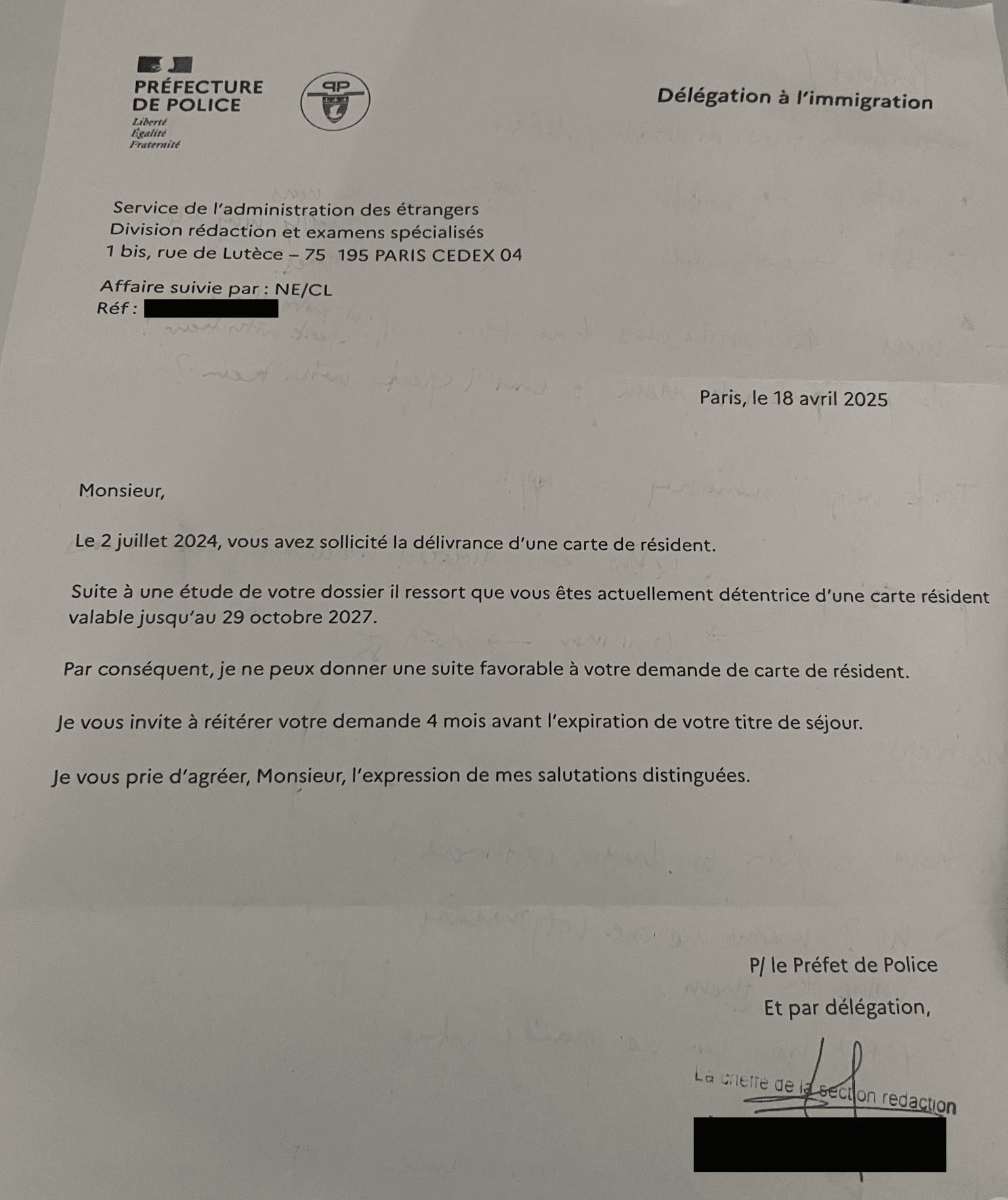
Yet the official website service-public.gouv.fr is perfectly clear:
You can apply for the carte de résident de longue durée-UE when renewing your residence permit or at any time when you meet the conditions.
I met all the conditions: over five years of residence, stable income. The rejection had no legal basis.
The battle with the préfecture
Faced with this unjustified rejection, I didn't give up. I followed up with the préfecture — by post, by phone, by every possible means. Without my persistence, my file would have been shelved and forgotten. Following up again and again, repeating the same arguments, citing the same legal texts — it's exhausting, especially when dealing with an administration that doesn't seem to have time to process your application properly.
After several weeks of follow-ups, the préfecture finally responded. This time, they asked me to submit all the supporting documents to complete my file.
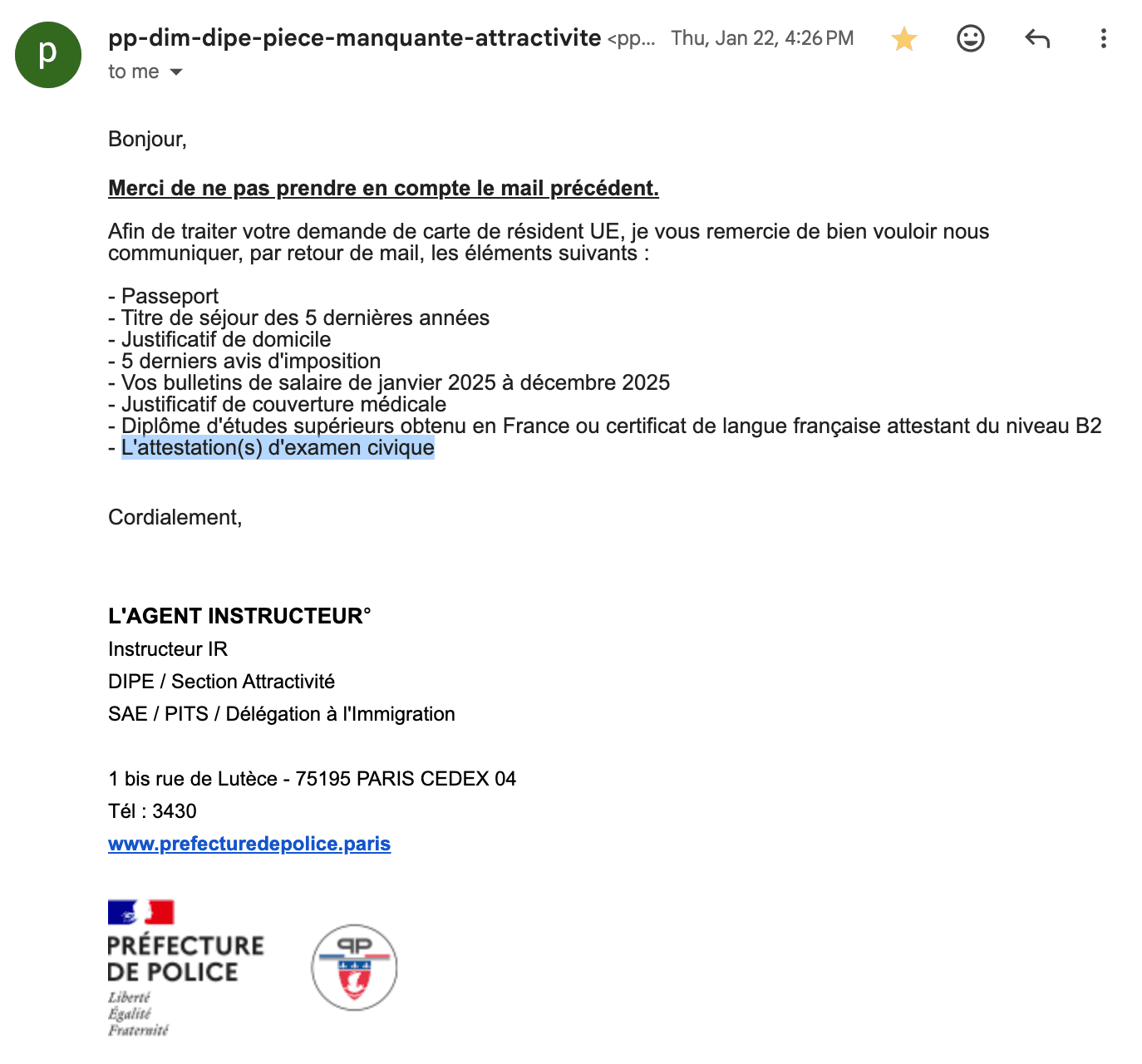
After months of silence and an unjustified rejection, the préfecture finally agreed to process my application.
The civic exam certificate
Going through the list of required documents, most were predictable: passport, residence permit, proof of address, tax notices, ID photos…
But one item stopped me in my tracks: the civic exam certificate.
In six years of living in France, I had never heard of this exam. I searched online — almost no results. No clear guide, no preparation platform. What exactly do they ask you? How do you prepare? Nobody seemed to have a clear answer.
Why I created Gaulo
It was this experience — finding myself alone facing an administrative requirement with no resources — that sparked the idea for Gaulo.
The only preparation method I found was to go to the official government pages and memorise everything — dozens of dense pages with no structure. Thousands of people in my situation were doing exactly the same thing. There had to be a better way.
That's how Gaulo was born — a platform to help foreign nationals in France prepare for the civic exam. A tool that structures the knowledge, offers quizzes, and makes preparation accessible instead of leaving it to brute-force memorisation.
What now?
As I write these lines, the story isn't over yet. After submitting my complete file, I received a summons to appear in person at the préfecture in April 2026. Almost two years after my first letter sent in June 2024.
Fingers crossed. I'll update this article when I have the outcome.
What I've learned
In the meantime, this experience has already taught me several things:
- Know your rights. Official legal texts are your best weapon when dealing with the administration. When an officer tells you you're not eligible, check for yourself on service-public.gouv.fr.
- Don't be passive. The administration won't come to you. If you don't get a response, follow up. If the response is wrong, challenge it.
- Document everything. Keep a copy of every letter sent, every response received, every exchange. It's your proof in case of a dispute.
- Be patient. Delays are long, responses sometimes absurd, but persistence pays off.
If you meet the conditions, you have the right to apply for the carte de résident — and to insist if your application isn't handled properly.
Steps to apply for the carte de résident
Here are the main steps, based on my experience at the Paris préfecture:
- Check your eligibility — review the conditions on service-public.gouv.fr (length of residence, income, etc.).
- Identify your préfecture — the process depends on where you live. Some préfectures offer online messaging (as Paris does now), others require registered post.
- Send your application via the channel specified by your préfecture.
- Follow up if you don't receive a response after several weeks.
- Compile your file — the supporting documents required:
- Full birth certificate (with most recent annotations)
- Passport (civil status, validity, entry stamps, visas) or consular certificate / ID card / consular card / nationality certificate with photo
- Proof of address less than 6 months old
- 3 ID photos
- Signed commitment to respect the principles of the Republic
- Proof of regular and uninterrupted residence for 5 years (residence permits, receipts, school certificates, tax notices, etc.)
- Proof of sufficient and stable income over 5 years (pay slips, tax notices, employment contract — social benefits are excluded)
- Health insurance proof
- Proof of French language proficiency at B1 level (diploma, test or certificate)
- Civic exam pass certificate with "carte de résident" mention
- Submit the complete file to the préfecture.
- Wait for the summons to the préfecture to finalise the application.
If you're in the same situation
If you're applying for the carte de résident and, like me, you discover you need this certificate, don't start from zero. Test your level with our free civic exam QCM, 40 corrected questions with no sign-up, or go straight to our guide on the civic exam for the carte de résident to know exactly what to expect.
Official sources
- Carte de résident de longue durée-UE — conditions, procedures and required documents
- Passeport talent — information on different categories